
Media reports at least 141 people dead triggering what appears to be Morocco’s deadliest migration disaster in recent history. 63 bodies were reported as recovered from Moroccan waters, while Spain reported 78 recovered from the sea on the Spanish side of the border. A mass incursion by around 72,000 (accounts vary) people from Morocco into the Spanish autonomous city of Ceuta on the northern coast of Africa between 28th – 31st July 2026.
Whilst the vast majority were relatively promptly returned to Morocco, some estimated four to eight thousand or so remained (at time of writing) including around 250 unaccompanied children in Ceuta. Nearly three weeks after the mass border crossing, thousands remain stranded in precarious conditions, many still lack adequate shelter, food and medical care. Many are asylum seekers from countries like Sudan, Egypt, Yemen, Chad, and Mali. Some told aid workers they would rather die than return to Morocco.
Spanish Interior Minister Fernando Grande-Marlaska said, except in rare cases involving extreme vulnerability, migrants who had entered irregularly would not be allowed to stay in the exclave, travel to mainland Spain or obtain legal status. The Ministry of Inclusion, Social Security and Migration created four temporary and extraordinary humanitarian assistance centres as between the Minister of, Elma Saiz, and the president of the Autonomous City of Ceuta, Juan Jesús Vivir.
The president of Ceuta’s devolved government, which is only equipped to deal with 90 minors in the event of emergency, earlier appealed to central government of Spain to urgently assist; in tern the national government is asking other autonomous regions to step up up to accommodate the migrant youngsters who cannot merely be assisted back across the border with Morocco.
The Spanish Red Cross has distributed approximately 4,000 feeding kits daily as well as feminine hygiene kits. In addition, socio-health care has been provided to more than 4,000 people in the city. Minister Saiz said “Our work here is aimed at ensuring proper humanitarian care, protecting fundamental rights and preserving people’s dignity, while accompanying Ceuta on the road to restoring normality as soon as possible.”
This isn’t the first time the border with the Spanish exclave has been breached in large numbers. Around 8,000 people entered in 48 hours in May 2021 after a diplomatic standoff over Western Sahara. In 2022 at the Melilla (another Spanish exclave) border crush killed at least 23 people, according to the official toll, while rights groups recorded 37 deaths. Fifteen people died at Ceuta’s Tarajal beach in 2014.
So what happened this time?
Data analysis from Golden Owl, a Spanish based intelligence company, shows that this was not some spontaneous event, but a Morocco wide, “coordinated, pre-built and advertised operation, run as a distributed network across a closed coordination core” through public Facebook groups with over “one million disclosed memberships, and dozens of self-assembling recruitment cells.”. They also report an “incitement window” beginning 19th March 2026 leading up to, and passing the end of July calling for further incursions on 15th August. “See you there on the 15th. Be there on time,” is one of the catchphrases circulating on social media apps like Facebook, InstaGram, WhatsApp, TikTok, etc.
August 15th came and went, but on Sunday 16th, hundreds of migrants, among the estimated 5,000 to 8,000 who remained in Ceuta, staged a protest on a popular beach, urging Spanish authorities to grant them asylum instead of sending them back to Morocco.
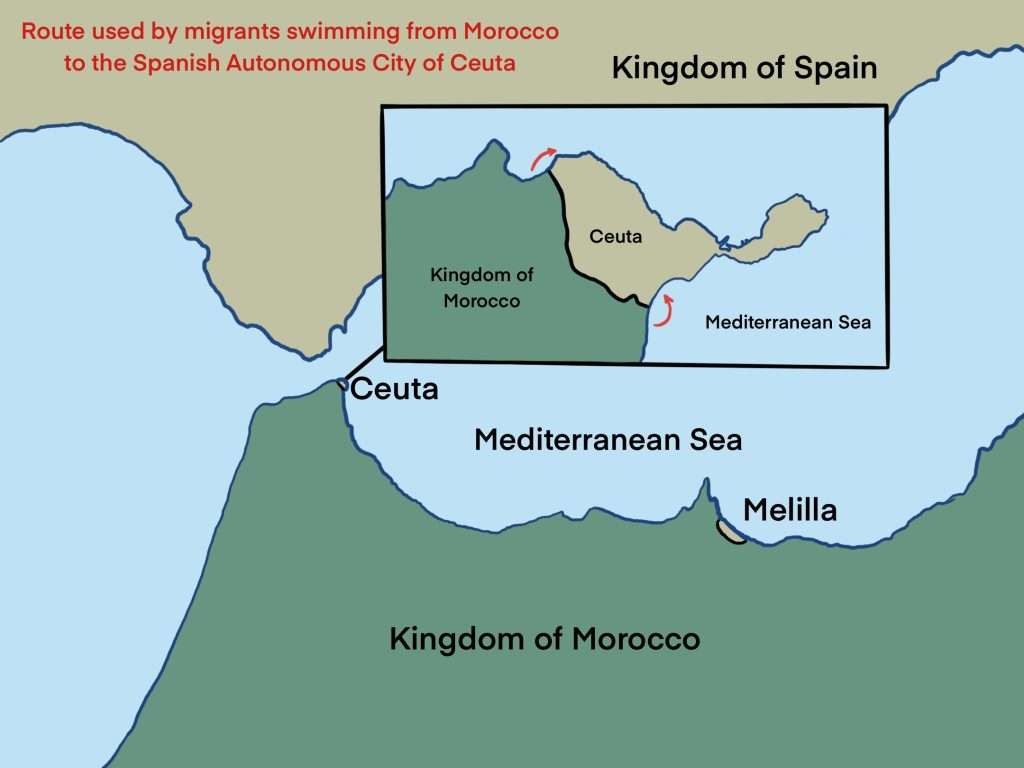
Moroccan authorities opened the gates at the Tarajal border crossing on 30th July and tens of thousands of mainly young, male Moroccans flooded through. Video evidence shared on line shows lorry loads of young men being driven near to the border crossing. Thousands of others took to the sea to swim across the border and arrive on the Spanish side of the border fence that ends at a rock outcrop into the Mediterranean Sea.
Why Ceuta ?
Ceuta, an area of just under 20 square kilometres on the northern coast of Africa, is seen by many as a gateway to mainland Spain. As Spanish territory, the autonomous city is part of the EU, but is subject to special Schengen (common travel) Area strict controls at Ferry and heliports – travellers in and out have to produce identity documents proving their eligibility to enter or leave. Similarly there are border controls with Morocco providing “regulated and controlled transit, with all the relevant documentary and security procedures.”
It has been reported that a Spanish Supreme Court decision regarding migrants arriving by sea, where there is no identifiable border, could not be “hot” returned immediately on arrival, unlike those in this case who came through the land border. In response, Spain fitted a floating pontoon style border marker in the sea from the rock outcrop at the broder line.
Since 12th June 2026, a reformed Common European Asylum System is in force – screening at the border, accelerated procedures, and a newly agreed Return Regulation applies. The Spanish government have reinforced the civil guard and national police presence in Ceuta along with supportive health staff and assistance from non governmental organisations. Added to this is 25 million euro funding aimed at providing for unaccompanied minors (who cannot legally be swiftly expelled due to their age and vulnerable status).
While Spain were praised for the swift response to the incursion, some member states of the European Union were not as supportive. Similarly, right wing political leaders and parties were highly critical, with far right Vox party going full Spanish First and saying not one Euro should be spent on accommodating migrant youngsters either in Ceuta or in dispersal centres across mainland Spain.
The Schengen Area – common travel zone – and EU borders
Italy’s right wing government swiftly moved to reintroduce air and sea border controls on arrivals from Spain, notwithstanding that no one was able to enter mainland Spain, and thus the common travel area, who wasn’t entitled to. Citing this firstly as a “necessary choice to safeguard the security of our citizens and defend the European borders” then two weeks later as a “national security issue”. Spain’s government gave Italy a warning that it would reciprocate if Italy’s border controls were not rescinded, then in tit for tat imposed the same restrictions on arrivals from Italy.
The EU Commission considers that this was a test of our European resilience and of the security of EU external borders, adding “Europe has not had this much control over illegal migration in a decade. But of course, the events from Ceuta show that dramatic images beat the best statistics”.
Be the first to comment