
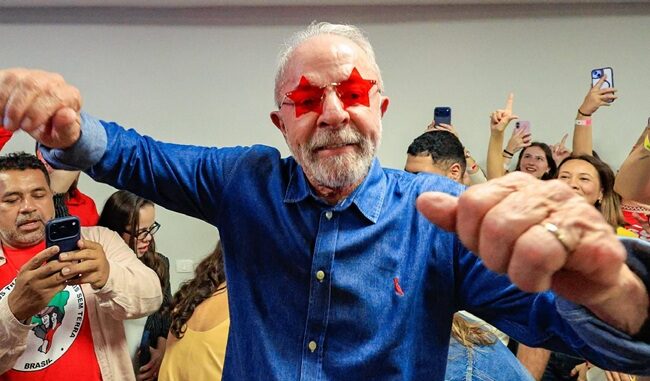
Against the odds, Luis Inácio Lula da Silva won a historic victory and fourth term as President of Brazil, soundly beating far right opponent Flávio Bolsonaro in a second round of voting. Bolsonaro disputed the results, then fled the country after being ordered to hand over his three passports (Brazilian, diplomatic and Italian) in connection with suspected irregularities in the financing of a film about his father, former President Jair Bolsonaro, and allegations of money laundering through an online gambling business and financial irregularities linked to his friend and lawyer Willer To.
Against the odds
Interference in Lula’s election campaign came in many forms.
- In a court petition, Lula’s team complained that tech giant Meta had favoured the right-wing contender’s content, giving Bolsonaro an advantage. Among other things, they claimed that for a 24-hour period, Lula was unable to boost his Instagram posts, while Bolsonaro could. Several watchdogs and human rights groups also said they found evidence of bias in Meta’s algorithm. Plus in August, Amnesty International was warning that election adverts containing disinformation were slipping through the cracks in Meta’s monitoring systems.
- The Superior Electoral Court (TSE) received 1,565 complaints of irregular online campaigning during the second round of the presidential election, making it the leading complaint among potential electoral crimes.
- Lack of buses during the second round of voting leads to lawsuits in places. Passengers reported queues, delays and reduced bus service during the second round of the presidential elections. Complaints led political parties to file lawsuits with Electoral Courts seeking the restoration of cancelled bus services.
- The weather didn’t help. heavy rains fell on the second round election , with road closures which led to requests to extend voting hours.
“Lula’s Army”
81 year old Lula didn’t even have a smartphone until four days prior to the election, but social media played a huge part in him overturning Bolsonaro’s lead in the second run-off vote. Brazilian lawyer and congressman Andre Janones, spent the final weeks of the run-off building a mass online movement to get Lula over the 50% line. “He played an exponential role in this campaign in lifting the morale of our troops every day, morning, noon and night,” Lula said.
His WhatsApp channel, launched months earlier, called “Lula’s Army” (Exercito do Lula) which had around 50,000 followers at the first round, where Bolsonaro got 47% of the vote, to Lula’s 45%. By election day, Lula’s Army had grown to almost 11 million subscribers, with Janones widely credited with helping Lula stage his comeback. For the second round the campaign was more effective telling the story of the president’s working-class past.
Bolsonaro mocked the president for having only nine fingers during the final televised debate, Lula responded recalling how he lost a finger at 17 while working a night shift at a factory, linking his experience to workers injured as a result of employers’ negligence. UnlikeBolsonaro, he reminded voters, he “knew the world of work because he had lived in it.”
After the debate, Janones spread the message online, promoting the hashtag #SomosTodos9Dedos, or “We Are All Nine Fingers”. Supporters shared the slogan, with some posting photographs of their own amputated fingers in solidarity. Janones also publicly called for simpler, less polished campaign videos that showed a more relatable side of Lula, and started posting more informal, selfie-style videos.
Bolsonaro ran away
Brazilian authorities are apparently investigating whether the defeated Bolsonaro was taken out of the country in a pre planned operation. Others are comparing Bolsonaro’s disappearance to an “extraction” rather than “escaoe”.
CNN Brazil reported on 30th October 2026 that an as yet unnamed former Mossad officer arrived from the USA into Brazil 6 days before the run-off election, and after that he travelled with Flávio Bolsonaro from Brasília to the Argentine border at Foz do Iguaçu. Security footage recorded the crossing and investigators matched the number plates of two vans, one supposedly containing the agent and Flavio Bolsonaro, the other with Flávio’s wife and their two daughters.. The drivers said nobody in either vehicle had to show a passport.
A Gulfstream G400 private aircraft , registration LV-JQW, operated by the Argentine charter firm Baires Fly. flew from Misiones and landed at Opa-locka executive airport in Miami at about half past ten on the Wednesday morning. Apparently Flavio entered the United States on a diplomatic passport that the Brazilian Federal Police had already cancelled. Brazilian officials say Argentine and United States state actors assisted, that false information was circulated to point attention at the wrong place, and that the whole thing ran under an internal name, operação Alba.
The New York Times reports that Jason Miller, a Trump strategist now holding a post at the White House, arranged the private flight. Asked about it at the G20 foreign ministers’ meeting in Atlanta, Marco Rubio said: “We did not participate in any of the preparations he made to leave,” and added, “at least, the US government was not directly involved in any of those moves.”
This was obviously pre planned – Bolsonaro had just lost a presidential election was ordered by the Supreme Court to surrender his passports, and three days later he was in Florida.
Be the first to comment