
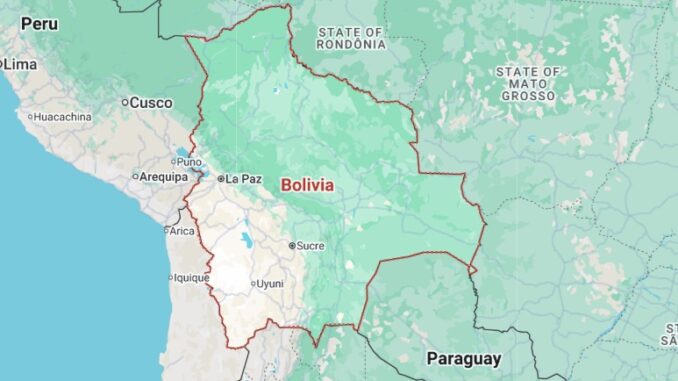
A video recording of a presentation by the author of this piece can be viewed on our YouTube channel
https://youtu.be/SjyJS2DSJoM?si=BmIEIxA53t8zveOB
In 2005 Bolivia was about the poorest country in Latin America, despite having ‘given’ immense wealth to Europe. The ‘Cerro Rico’ hill at Potosí has yielded an estimated 60,000 tons of silver. However, mining in Bolivia gave misery and early graves to the miners, never riches.
A basically bourgeois revolution in 1952 led to an agrarian reform, the peasants got land but little else. Neoliberal policies of austerity were imposed in the 1980s. Resistance to them grew, in a population with a large proportion of indigenous communities which still have strong collective organisation and discipline. Much of the rest of the population is ‘mestizo’ with indigenous roots but a small elite of European descent has always ruled the country.
A militant, successful ‘water war’ against privatisation in Cochabamba in 2000 was followed by a militant, successful ‘gas war in 2003. At the cost of 67 deaths, the export of the recently discovered natural gas reserves by transnationals at favourable terms was defeated.
THE ORIGINS OF EVO MORALES
One of the best organised popular movements is that of coca leaf growers in the tropical area, 4 hours by bus from the city of Cochabamba. Evo Morales is their recognised leader. What is their origin?
After the bourgeois revolution and land reform of 1952, the peasant population in the cold, dry highlands (altiplano) of Bolivia began to increase. As population pressure grew, some government thought it a good idea to move some people to the hot, wet underpopulated land in the Amazon basin near Cochabamba. They were given land, some plants and virtually nothing else.
I saw the situation in Chapare in 1973: they grew bananas on small plots and lived in misery, with no infrastructure, no government marketing and no hope. They were paid the equivalent of 5 pence for a pile of about 15kg of bananas. Intermediaries took all the profit. So when they were offered good prices for coca leaves, they had no doubt in taking them. Coca leaves are traditionally chewed by many Bolivians – they have a soothing effect and relieve hunger and tiredness. They can also be processed to produce cocaine, and these coca growers were being well paid for their leaves. By 2001, when I saw the area again, strong cooperatives had been created, with good buildings. Evo had been elected as one of two anti-imperialist deputies to the national congress. As a political instrument, in 1997 they had established the MAS-IPSP: Movement To Socialism – Political Instrument for the Sovereignty of the Peoples. It is generally known as MAS, but its full name indicates that it was an instrument for social movements.
VICTORY AND TRANSFORMATION
In 2002, MAS won second place in general elections, with 34% in the run-off ballot. This scared them witless because they were totally unprepared to govern. A process of rapid development of the MAS followed. In 2005 Evo Morales was elected, with an unprecedented absolute majority of the votes and the first ever indigenous President. MAS had a majority in the Congress from then until 2025.
With Evo Morales, and then Luis Arce as President, Bolivia has been transformed. The large natural gas and oil deposits were nationalised. The country now receives 80% of the income, instead of 18% as before. A large factory to produce Urea, an important fertiliser, using natural gas, was built and in 2025 there were 100 industrialisation projects underway.
Most importantly, a new constitution was written and approved in 2006, declaring Bolivia to be ‘Plurinational’. The majority indigenous population (especially Aymara and Quechua) were recognised after centuries of enslavement and marginalisation. Racial discrimination was outlawed. The change in their status, how they see themselves, is evident.
So things went well, in general, until 2019. Evo’s lack of formal education was compensated for by the professionals in his cabinet, above all Luis Arce, a socialist economist, as minister of the economy.
A universal pension was introduced – small but important to the impoverished majority of the people. Also, small education grants encouraged school attendance from primary level up.
In these 19 years Bolivia has seen impressive growth rates. GDP doubled between 2006 and 2014, and extreme poverty fell from 38% to 18%. Many aspects of life have been transformed, with subsidised fuel, a lot of high quality construction, a network of 12 ‘teleféricos’, cable cars around La Paz, the biggest city.
MAS has defined its ideology as “Communitarian socialism to liberate Bolivia from the colonial state”, envisioning the path of a ‘cultural and democratic revolution’ in Bolivia. It has been consistently anti-imperialist in foreign policy, and was the third member of the ALBA alliance of nations (Bolivarian Alliance for the Peoples of Our America) after Cuba and Venezuela.
PRESIDENTIAL ELECTION RESULTS:
Percentages
2002 MAS Evo Morales 21
2005 “ “ 54
2008 recall referendum 67
2009 “ “ 64
2104 “ “ 61
2109 “ “ 47
2020 “ Luis Arce 55
2025 “ Eduardo del Castillo 3
Evo won a recall election in 2008, and was re-elected in 2009 and 2014. Under the new constitution, that should have been his limit. However, his personal ambition was not satisfied. In 2018 he called a referendum, to allow the over-riding of that limit. He lost, but then appealed to the Constitutional Court, to allow him to stand again in 2019, because term limits were against human rights. This created a lot of bad feeling, and so his margin of victory in 2019 was narrow. Delays in the count led to Evo asking the Organisation of American States to audit the votes – a big mistake. The OAS immediately claimed there was evidence of fraud, a claim which itself lacked evidence.
2019 COUP AND REPRESSION
This gave the excuse for the armed forces chiefs to ‘ask’ Evo to resign, as right-wing groups and police moved the intimidate MAS supporters. Thus a brutal right-wing regime was established, which set about reversing the popular gains of 14 years. Promised new elections were repeatedly delayed, until mass pressure, with road blocks isolating the biggest cities of La Paz and El Alto, forced the issue. Thus new elections were held in 2020, and Evo’s party won with 55%, with Luis Arce as president.
DIVISION OF THE MAS
Arce continued with the MAS programme of development, with 100 industrialisation projects including a major steel plant near a big iron ore deposit. But Evo Morales continued to insist that he be able to stand for re-election, against his constitution and all legal rulings. MAS became two factions, one supporting Arce and a smaller one supporting Evo.
The country has probably the biggest reserves of lithium in the world, easily extractable from salt lakes as in Argentina and Chile. A joint venture with a German company to produce batteries was cancelled after the 2019 coup. Another venture with a Chinese company was still at the investment stage and was cancelled after the 2025 election.
Recent economic problems also greatly reduced the popularity of MAS. Natural gas production has fallen, and Argentina no longer needs it. Exports are down and a combination of the right wing and Evo supporters in the congress blocked the government from obtaining dollars to import diesel and other fuels. So there were transport problems, and the resulting shortages of goods. In view of this, Arce declined his right to seek re-election, and another leader of MAS stood in 2025.
2025 ELECTION DISASTER
The MAS vote collapsed to 3%, and there was a run-off between two right-wingers. One was a known far-right figure from the Santa Cruz lowlands. The other, a milder unknown, standing as a Christian Democrat.
So the popular vote went to the latter, Rodrigo Paz. He was elected and has proven to be another pro-imperialist, setting about selling the country’s resources. In view of the fuel crisis, he ended the large government subsidy. This meant a big increase in the cost of living, but the people accepted this as necessary. However, other austerity policies, the moves to sell off natural resources, privatise state companies and in general cosy up to Trump have provoked massive protests.
2026 MASSIVE PROTESTS
President Paz and others have tried to link the protests to Evo Morales – linked with the idea of drug traffickers – but he is not visible physically nor metaphorically. Physically he is hiding in his stronghold of the Chapare from an accusation of human trafficking arising from an alleged child born from a relationship with a minor.
The leaders of these protests are the leaders of the strong social movements: the COB (Central de Obreros Bolivianos – Bolivian Workers’ Centre), the peasants’ CSUTCB (Unified Confederation of Peasant Workers’ Unions of Bolivia) which is affiliated to the COB, and the indigenous communities, including the important Bartolina Sisi National Federation of Indigenous Peasant Women of Bolivia (Federación Nacional de Mujeres Campesinas Indígenas Originarias de Bolivia – Bartolina Sisa (CNMCIOB-BS)). Using the now traditional method of roadblocks, they have isolated the main cities of La Paz and El Alto (which really form a single unit), causing shortages of food, fuel and medicines and so on.
President Paz wavers between threats of repression and calls for dialogue. Arrest warrants for two leaders were revoked, to try to obtain dialogue with them. At the same time a law was passed to allow the army to repress protests. Doctors have called for a moratorium, to allow medicines to enter La Paz, and meats are in short supply and expensive.
The roadblocks continue, however, and leaders seem determined to continue until Rodrigo Paz resigns. The political problem remains of who would form a real alternative leadership, in the case that new elections be called. Much as he would like, Evo Morales is not being considered now. Luis Arce is in prison, suffering a another case of lawfare.
There are other possibilities such as Andronico Rodriguez, a young former President of the Senate from the Chapare who has recently called for a recall referendum. The COB leaders, though, reject this and insist on the President’s resignations and new elections within 90 days. There is everything to play for but no clear road ahead at the moment. The only fairly clear prognosis is the Rodrigo Paz will not stay in office for his five year term.
WHAT NOW?
The present situation is fraught with political danger. Rodrigo Paz thought he could revert to politics as they were before 2006, before Evo’s election and the incorporation of the people into active participation, before the liberation of the indigenous peoples from their position of marginalisation. So these popular movements are very strong but spontaneous, without a conscious political leadership.
The roadblocks are causing real hardships for the people in the cities, and even deaths from the lack of oxygen and other medical supplies to hospitals. Food prices are soaring, and so there is a lot of anger at the protesters.
Repression has begun. The intransigence of the largely rural organisations leading the roadblocks, the refusal to negotiate, could be disastrous. If they are successful, Paz resigns and new elections are called, the left might again be defeated and the mobilisation come to nothing. There is no clear alternative political leadership at the moment.
So the best outcome at the moment, paradoxically, would be the temporary defeat of the protests, hopefully without too much blood spilt. A process of political maturation is needed, to produce a coherent alternative that can attract both the rural and urban masses.
Be the first to comment