

The “MariCarmen” effect leads to a general election
The 23 September 2026 forcible viction in Madrid. Spain, of 87 year old Mari Carmen Abascal, whose image being removed from her apartment building on a stretcher went round the world and sparked encampments and demonstrations in cities across the country. The case spurned Spain’s socialist led minority coalition government, having been negotiating two new housing laws with coalition partners, to put forward two new housing laws which were debated and voted on in the country’s lower house on Friday 2nd October 2026.
With hundreds of protestors outside the parliament, both laws were rejected in the Congress of Deputies (the lower house) All the right wing parties, including Junts por Catalunya (who have given tacit support most of the time to the minority left wing coalition government). Outside there were chants of “Your profits, our misery” from the gathered crowd. But the rejection only served to spark even more, and much larger protests
Over the weekend, an encampment in the centre of Madrid, set up since 23 September and organised in the main by the renters union, only grew in size, populated by young and old, supported by trades unions alongside renters and homeowners, in major ciities across the country there were more marches and demonstrations in favour of the new housing laws.
Prime Minister Pedro Sánchez spent the weekend consulting with colleagues and advisors and, early on Monday 5th October, called an early general election for November 29th 2026. Is he taking heed of the huge public reaction to the rejection of the proposed laws? September’s national polling Sánchez’s socialist party has lost ground to a potential 26.3%, with left wing coalition partners also losing voters while the centre right PP (People’s Party) and far right Vox both showing increased support.
So, is the current impasse on measures to lower rents and make stable, affordable housing available causing another “15M” moment, which, in 2011, saw a massive wave of peaceful protest across the country against austerity, poverty, unemployment, corruption and the majority’s lack of voice in the then two party system of national government. It spawned the birth of the Podemos (we can) Party, with subsequent breakaway group SUMAR currently working with Sánchez’s socialists in government.
The Spanish parliament is dissolved on 6th October, the general election will take place on Sunday 29th November.
Meanwhile the picture of Spanish encampments has spread – in Dublin there has been an explicit demonstration of support. Likewise in the Hague and Potsdam, and in Berlin a camp is in place outside a hotel that its real estate fund owners wish to demolish. In Spain there are calls for a national strike over the cost and availability of housing (house prices have risen around 80% since 2010, while rents have nearly doubled over the last decade).
So can Sánchez pull an election win out of the housing crisis hat? New York democratic socialist mayor Zohran Mamdani was elected on promises to build new affordable homes and introduce rent controls, hopefully Pedro picked up some tips from him on his recent visit to the big apple.
Background
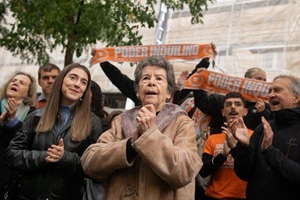
MariCarmen Abascal, who is 50% disabled, has lived in the apartment in the Retiro district of Madrid since 1956. The lease was originally signed by her father during the Franco dictatorship, under a 1955 law. The father died in 1960 and Mari Carmen’s mother assumed the lease; she in turn died in 2005, MariCarmen assumed the lease. In 1964 a new Urban Lease law was introduced and, in 1994 another one, both intended at “the gradual elimination of the rights of subrogation upon death ”. The effect was that second assumption by a child could only be for two years. Provincial Court proceedings in 2007 confirmed the expiration of the lease as November that same year. MariCarmen continued as tenant and paying a controlled rent of around 500€ a month.
The city of Madrid social services offered Mari Carmen the option of moving into residential care or supported housing in 2005, offers she refused saying “, I insist, I’m perfectly capable of living on my own.”. Since then she has asked the city council again and been told the waiting lists are very long. The property investors that currently own Mari Carmen’s apartment did offer her the chance to buy it , but she didn’t have the money and, at her age, no bank was likely to give her a mortgage. The owners (Urbagestion) are reported to have wanted to raise the rent to 2600€ a month, more recently stating they are willing to start negotiations with a starting discount of 40%.
5 days after the eviction, with MariCarmen still hospitalised, meetings were held between her lawyers, the owners and Madrid city council. The end result was that she can move back into the apartment and pay rent equivalent to 30% of her income for up to 8 years. Her lawyer commented that the agreement came “late” and after “a situation no one should ever have to endure,” but that it is obviously “a better and happier outcome for everyone.”
Be the first to comment