
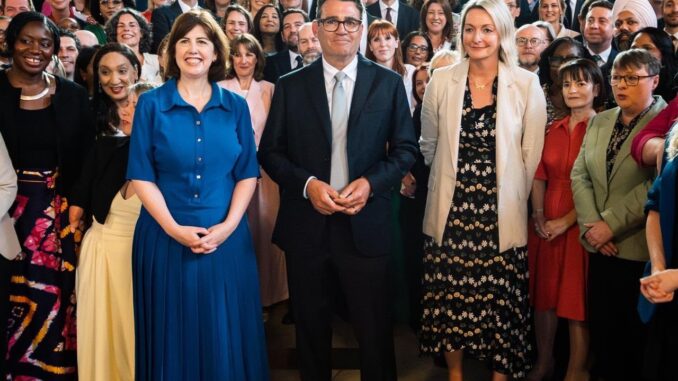
Greater Manchester Mayor, Andy Burnham beat Reform UK candidate Robert Kenyon by over 9,000 votes, winning nearly 55% of the vote (24,937 votes) on 18th June 2026. Burnham is no stranger to the area, having been MP for the neighbouring constituency (Leigh) from 2001 to 2017. He is pictured here on his first day back in the UK parliament, only a short time after the country heard from Keir Starmer that he was resigning as leader of the UK Labour Party and that he would remain in post until a successor was elected … yet here is Burnham pictured as though he has already become Labour leader.
The same Burnham that, in February 2026, was banned from standing as a UK Labour candidate in the Gorton and Denton by election, called on the resignation of Labour MP Andrew Gwynne on health grounds; the seat went on to be won by Green Party candidate, Hannah Spencer, with Labour coming in third place after Reform UK’s Matt Goodwin.
Take a few steps back and we maybe should ask where was the democracy in selecting Burnham as the Labour candidate?
Firstly, the parliamentary seat was vacated by sitting MP Josh Simons who only took the seat at the 2024 General Election. Maybe worse was that on 14 May 2026, Simons announced he would be standing down from Parliament, specifically in order to allow Burnham to contest that seat in a by election. So, Simons (and Labour Together) chose the candidate, essential to replace Prime Minister Kier Starmer.
So what are Burnham’s policies?
- The economy
He has committed himself to current chancellor of the exchequer’s fiscal rules, so there is little hope of him, in government, increasing government borrowing. He also favours continuing Labour’s manifesto promise not to increase the main rates of income tax, VAT or National Insurance (already partly broken by the increase in employers’ NI contributions). Burnham, on the BBC TV programme Newsnight said he wanted to reconsider the increase in employers’ NIp, brought in by Rachel Reeves in the 2024 Budget.
Overall he will have little room to increase public spending through either borrowing or raising more tax. More money will be required to maintain his commitment to the pensions “triple lock” that increases the state pension each year in line with inflation, average earnings growth, or 2.5% – whichever is highest.
Prior to being elected back to Parliament, he suggested support for cuts to student loan repayments, and compensation to1950’s born women whose pension age was raised from 60 to 65. Both these items are no longer on his agenda.
- Public utilities
On winning his Makerfield seat, Burnham said “We do need to bring down water bills, energy bills, rail fares, just as we brought down bus fares in Greater Manchester, to make life more affordable for people”.
He has committed to “public control” of public utilities – but that already exists, the regulators have consistently failed to “control” privatised water and energy companies, witness the water industry burdened with debt and providing poor service to customers, plus damaging the environment with constant sewage spills.
His bus project in Manchester has provided more “control” over the private companies running services there. Will he in government be able to offer the same, when public opinion appears more to favour public “ownership”, as in nationalisation, of monopoly services.
- The National Health Service
Under Prime Ministers Tony Blair and Gordon Brown, he held several government roles, Minister of State for Health, and as Health Secretary.
In these roles, in 2009 he blocked a Statutory Enquiry into the “tainted blood” scandal; blocked another Statutory Enquiry into failings in Stafford Hospital, where around 1200 people had died due to apparent neglect, ignoring 81 separate requests from grieving families, opting instead for a private independent review (which was subsequently replaced by a full Public Enquiry by the incoming Conservative/Lib Dem coalition government.
He oversaw arrangements for the UK’s first public hospital to be managed by a private company. The contract was eventually awarded in 2012, again under the Con/Dem coalition, only to fail spectacularly with Circle Health pulling out of the deal by 2015 after financial struggles and regulatory criticism.
By 2012, with Labour out of government, he was more critical of accelerating privatisation of NHS services, also suggesting that his party in government had gone too far in allowing private providers to compete for NHS contracts, and that some hospital building under the Private Finance Initiative had been poor value.
- Social Care services
Burnham is a long supporter of reform to social care provision. Successive governments (including his under Tony Blair & Gordon Brown) have significantly failed to achieve this.
His approach is apparently to replace inheritance tax, currently only paid in 4.6% of cases, with a national care levy which “everybody would pay but obviously the wealthiest would pay the most.”
In 2024 the Health Foundation think tank estimated an NHS-style model of universal and comprehensive care could cost around £17bn extra by 2035/6.
Brilliant, but where is the workforce to come from?
- Defence
He inherits an ongoing challenge between the Ministry of Defence demanding £28 billion more money up to 2030, and only being awarded £10 billion over the four years. Before the by election, and the day after two of Starmer’s defence ministers resigned from cabinet in protest, Burnham told The Times newspaper “I am not squeamish about saying that the plan would be to reduce the welfare bill. Not at all”.
- Housing
He launched his election campaign saying he wanted “the biggest programme of council house building since the Second World War”, perhaps by rediverting the £39bn affordable housing programme budget entirely to social rent homes. ( Using average build costs on local authority land). This could equate perhaps 210,000 new homes depending on where they are built and who by.
- Immigration
Burnham appears more in line with the right wing in terms of saying that he agrees with tougher policies recently brought in by Home Secretary Shabana Mahmood to address both legal and irregular migrant arrivals in the UK.
He said he would consider tougher measures to deter people from crossing the Channel from France in small boats, while also arguing that refugees need safe legal routes to Britain. Of course, were there legal routes, people wouldn’t need to risk their lives in boats run by people smuggling gangs.
He said people already in the country who are “left in limbo” by the immigration system need to be able to work, suggesting he could soften some of Mahmood’s measures.
Nothing here suggests that he gets the need for some migration, particularly to fill workforce gaps in public services, like NHS and Social Care, or industries with shortages of staff.
- Railway infrastructure
Specifically, the UK’s second high speed rail line, currently running way over budget, originally planned to connect London with Birmingham, Manchester, Leeds, and the East Midlands, although the Manchester, etc, sections were cancelled in late 2023 by the then Conservative government.
Burnham is keen to reinstate the cancelled section between Birmingham and Manchester and has suggested it could be funded by a windfall tax on the increasing value of surrounding land once the new railway opens. At the time it was cancelled, the cost estimate in 2023 was £36 billion, money which would have to be paid up front before any expected windfall, plus as a high-speed line, there are fewer places the train will actually stop at – land values won’t increase in areas that are merely viewing platforms for new trains whizzing past.
- European Union
In 2025 he said he wanted Britain rejoin the EU in his lifetime. On becoming the candidate for Makerfield, he said EU membership was not a priority.
“I’m not proposing that the UK considers rejoining the EU,” he said when launching his by election campaign. “I respect the decision that was made at the referendum.”
This is a turn round from his initially campaigning for Britain to stay in the European Union in 2016, and two years later, saying he would back a second referendum.
- Palestine / Israel
Burnham has long supported recognition of the State of Palestine, and whilst he has been a long-time supporter of Israel, he called Netanyahu’s 2015 re-election ‘depressing,’. In 2004, he accepted a trip to Israel funded by its foreign ministry / Labour Friends of Israel. He later visited Palestine at the invitation of a pro-Palestine group.
Most recently, a video has resurfaced from a past leadership campaign where he promised that the first country he would visit if elected Labour leader would be Israel.
Burnham has a long history of calling out antisemitism, especially within his own party. In 2018, he tweeted to call for his party to take a firmer stand against antisemitism. Then, in 2019, while the Labour Party was still under the leadership of Jeremy Corbyn, Burnham told the Board of Deputies at Manchester Town Hall that it is “inconceivable to me that a party which has prided itself on its record on racism could have become in embroiled in an [alleged] antisemitism crisis.” In May 2019, the Equality and Human Rights Commission (EHRC) launched an inquiry into whether Labour had “unlawfully discriminated against, harassed or victimised people” because they were Jewish.
In 2022, Martyn Forde, KC published a report, commissioned by Keir Starmer, that said the issue of antisemitism was being used as a factional weapon. The report also said that senior figures in Labour hostile to Corbyn and his supporters had slowed down the leadership in dealing with antisemitism and other forms of racism. None of the report’s findings or recommendations were acted upon.
Be the first to comment